
Email Template
Email templates allow you to create reusable email content frameworks.
Overview
Email templates allow you to create reusable email content frameworks that are ideal for scenarios requiring repetitive emails with personalized content, such as marketing campaigns, system notifications, and verification codes. By using variable substitution, you can achieve personalized email delivery with a single template.
To access the template management page, log in to the Aurora SendCloud platform and navigate to Content > Email Template from the left menu.
Template List
The Template List page displays comprehensive information for all templates in your account:
- Template ID - A unique identifier for each template
- Template Name - Template identification name for quick identification
- Type - Template classification type
- Invoke Name - Unique identifier used when making API calls
- Email Subject - Email subject line (maximum 512 characters)
- Update Time - Last modified time (automatically logged)
Search & Filter
Search
The search bar is located at the top of the Template List page. The search works across the following template attributes:
- Template Name
- Invoke Name
- Email Subject
Filters
In addition to the search bar, two dropdown filters are available to narrow down the list by specific attributes. Each filter allows only one selection at a time.
| Filter | Available Options |
|---|---|
| Email Type | All, Batch, Trigger |
| Editor | All, RTE, ShanEditor, Code |
Template Operation
On the Template List page, the following four action options are available in the rightmost column:
- Preview – Previews your email template in desktop, mobile, or inbox preview modes. This view is read‑only; editing is not available.
- Edit – Allows you to edit your email template, including the template name, invoke name, subject, email type, and email content. Note that editing opens the Shanedit in a new tab.
- Copy – Duplicates the selected email template. The copy retains the original template name and invoke name, with ”_copy“ appended to the end.
- Delete – Permanently deletes the selected email template. Caution: This action is irreversible and cannot be undone. You will be required to enter your password to confirm the deletion.
Batch Operations
On the leftmost column of the template list, you'll find checkboxes for selecting templates. You can:
- Select templates on the current page
- Select all templates across all pages
- Manually select specific templates by ticking individual checkboxes
After making your selection, batch operations become available at the bottom of the list:
- Delete selected – Permanently deletes all chosen templates. Caution: This action is irreversible and cannot be undone. You will be requiredto enter your password to confirm the deletion.
- Batch export – Exports the selected templates in a HTML format.
Template Editors
Aurora SendCloud provides two editing modes to meet different user needs:
- Features: Visual drag-and-drop editing, easy to use
- Target audience: Marketing and operations professionals with non-technical backgrounds
- Functions:
- Directly drag and drop text, images, and other elements
- Use a library of pre-designed professional templates
- Real-time preview functionality
- One-click copy and use existing templates
- Features: Direct HTML source code or rich text content editing with high flexibility
- Target audience: Developers and professional users
- Operation:
- Click the "Source" button on the right to switch modes
- Supports direct pasting of external HTML code
- Full code control capabilities
Previewing Your Template
Quick Preview (Desktop, Mobile)
Quick Preview allows you to view your email template in three basic modes: Desktop, Mobile. It is read‑only and gives you a quick visual check of the template’s layout, responsiveness, and overall appearance. For more detailed cross‑client testing with diagnostic reports, use Inbox Preview instead.
Inbox Preview (Advanced cross-client testing)
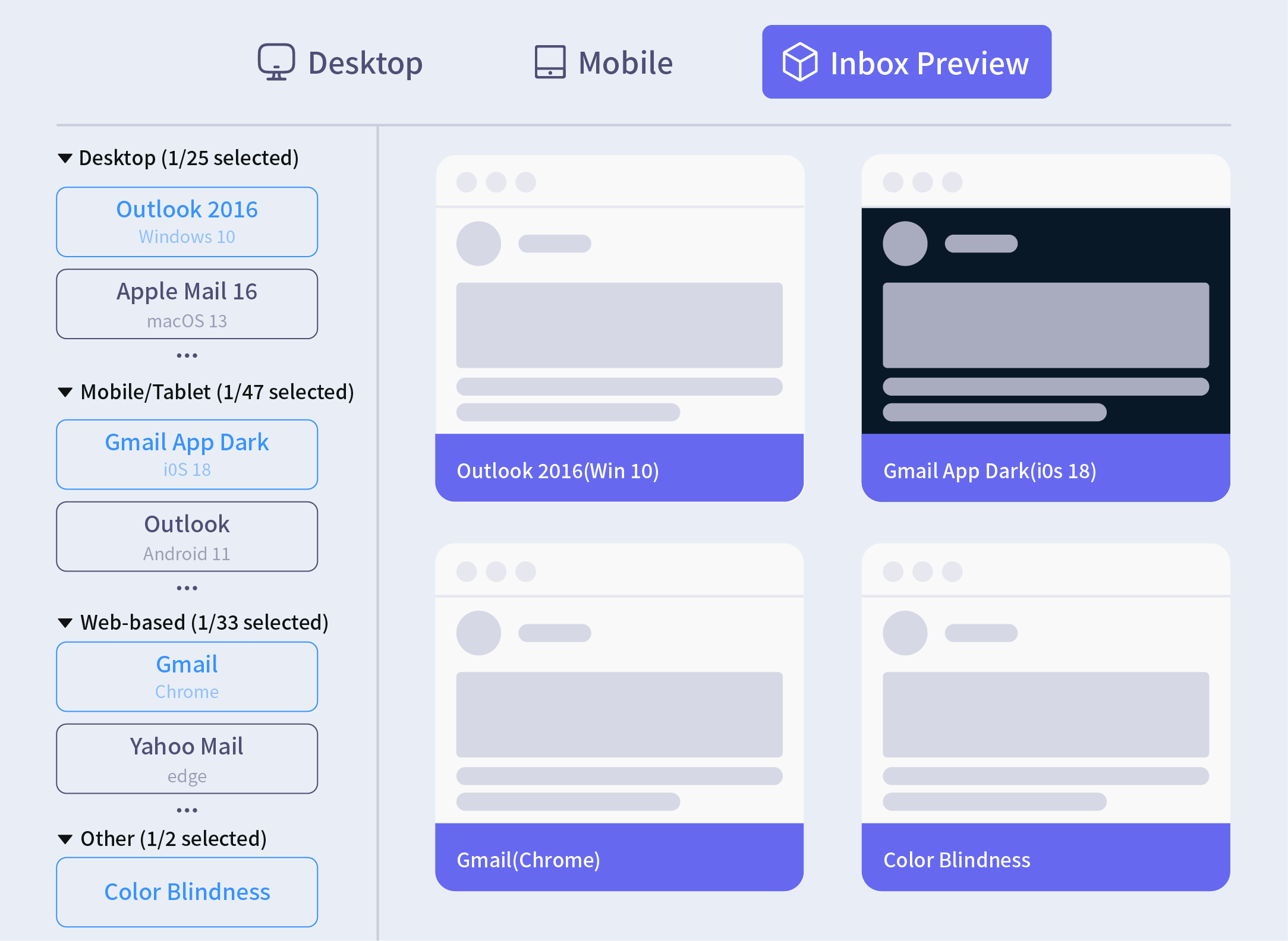
The Inbox Preview feature lets you test how your email template renders across a wide range of email clients, devices, and platforms before you send it. It helps you detect display inconsistencies – such as broken layouts, font mismatches, or dark‑mode issues – ensuring a consistent and professional appearance for every recipient.
Supported Clients and Devices
Inbox Preview covers over 100 popular email clients, including:
- Desktop applications – e.g., Outlook 2021, Windows Mail
- Mobile and tablet – e.g., Gmail on iOS, Apple Mail on iPhone, Samsung Email
- Webmail services – e.g., Gmail on Chrome, Outlook.com, Yahoo Mail
You can test all clients at once or select a subset that matches your target audience's usage.
Key Checks Provided
The preview offers detailed diagnostics for common design pitfalls:
- Email length – identifies content that may be truncated due to size limits.
- CTA placement – ensures your primary call‑to‑action remains visible above the fold.
- Image‑blocked view – simulates how your email looks when images are disabled (as in Outlook's default settings).
- Color and font compatibility – highlights dark‑mode colour inversions, font substitutions, and use of web‑safe fonts.
- Accessibility – includes a colour‑blind simulation to verify readability for users with visual impairments.
How to Use Inbox Preview
- In the template editor, click the Preview button and select Inbox Preview from the dropdown menu.
- Choose the clients and devices you want to test – you can select all or a custom list.
- Click Run Preview and wait for the screenshot generation to complete.
- Click any client name to view the rendered screenshot and inspect any design issues.
After you identify problems, return to the editor to make adjustments, then re‑run the preview to confirm your fixes.
How to create and send an email template?
This section will demonstrate how to create and send an email template using a fashion brand launching a new product.
Example : Creating a "New Product Launch Announcement" Template
The goal of this email is to introduce the new product line to subscribers, create anticipation, and directly drive sales.
Creating a New Template
1.Log in to Aurora SendCloud and go to "Content" - "Email".
2.Click "Template Create" and choose a template editing method, such as Shan Editor.
3.Set the basic template information:
- Template Name: New Product Launch Announcement
- Invoke Name: New_product_launch
- Email Type: Batch Email
- Email Subject (to attract opens higher open rates): New Product Launch | %product_name% Series, Now Available!
4.Design Template Content
Select from the template library or create a new template directly.
- Template library: Replace product images and modify product description text.
- Create a new template: Drag and drop components, upload product images, and modify product description text.
If you want to add variables (such as user names) to the template, please use %% to enclose your variable name. For example: %name%
Don't forget to add preview text. For example: Explore exquisite products and start a minimalist new experience...
5.Save Template
Preview the effect (especially on mobile devices), ensure all modules display correctly, and then click "Save".
How to Use This Template to Launch a New Product Launch Campaign
1.Log in to Aurora SendCloud and go to "Marketing" - "Campaign".
2.Click "Create Campaign" and set the campaign information.
- Send Content, Select Template: New Product Launch Announcement
- Select Target Audience: Choose the email list to send to, such as "All Subscribers" or a more granular segmentation list.
Set up Content and Variables: The system will load the template and replace the variables in the email template with the corresponding variable values from the contact attributes.
3.Test and Send
Be sure to send a test email: Send it to your own email address to check that all links (especially purchase links and discount codes) are correct.
Set Send Time: Choose to send it during the time when your target users are most active (such as a weekday afternoon).
Click "Save".
Usage Guidelines
Content Restrictions
- JavaScript is not allowed
- Styles and content should be concise and clear
- Responsive table static layout is recommended
- Email subject character limit: 256 characters
Template Type Matching
- Batch templates: Called by batch type API_USER
- Trigger templates: Called by trigger type API_USER
- Important: Ensure that the template type matches the API_USER type
Best Practices
Template Design Tips
- Use clear naming conventions to facilitate team collaboration
- Utilize variable substitution for personalization
- Regularly optimize and update template content
- Test display effects on different devices
Recommended Workflow
- Select the appropriate editor mode
- Design or edit the template content
- Set the template type and invoke name
- Save and test send
- Use the API to officially call and implement
Frequently Asked Questions
What might cause a template call failure? Please verify that the template type matches the API_USER and that the invoke name is correct.
How can I achieve responsive design? We recommend using an adaptive table layout to ensure proper display across different devices.
Is there a limit on the number of templates I can create? This varies depending on your plan. Please refer to your plan details for specific limits.
Getting Started
Ready to create your first template? Choose your preferred editor mode and start building personalized email content that engages your audience effectively.
Updated about 1 month ago